flash poll before tonite's Council Meeting

2,286 Views | 34 Replies | Last: 11 hrs ago by TXAG 05
Bob Yancy
How long do you want to ignore this user?
College Station has embraced Neighborhood Integrity (NI) as an overarching philosophy in the governance of our city. I'm interested in your opinions specifically regarding vehicular traffic in the context of NI.

1) Do you like quiet streets in your neighborhood, or a more urban, active environment?
2) If "quiet" on 1, are you willing to trade increased traffic on Texas Avenue and Barron and other major roadways outside of neighborhoods to achieve your idea of NI?
3) In new neighborhood design, do you think "connected grid pattern" is the way to go, or do you like enclave neighborhoods with some loop streets and cul de sacs?
4) which type of neighborhood did you grow up in? A seamless, high connectivity grid pattern of neighborhood streets? Or an enclave neighborhood? Or a rural, isolated setting?
5) Today, when you're running your errands around town, do you cut through residential neighborhoods to get where you're going faster?
6) With the above as context, what kind of new residential development should College Station employ?
7) any other comments about this topic specifically?

Thanks for the help

Yancy '95

(We are asking posters to answer the questions in a post using the numbers that Mr. Yancy has put in his post and not quote the post. If the post is quoted with the question by every user the thread will become difficult to read. -Thank you. -Staff]
EliteElectric
How long do you want to ignore this user?
Bob Yancy said:


1) Unrealistic goal. Streets are what they are and you choose your location of residence accordingly. "deserve quiet" is unrealistic for anyone to think.

2) [Not answered by poster]

3)I prefer cul de sacs and loops, we live on a cul de sac now

4) Grew up on a cul de sac in Los Angeles

5)I only cut through neighborhoods when traffic is at it's most congested, as a last resort. I prefer regular arterial routes.

6) A mixture of types, so that homeowners can choose where they want to live, you know, free market stuff.

7) Let the market determine what people like most. Those that prefer quiet can certainly choose it, those that prefer hustle bustle can choose as well. But under no circumstance take a quiet area with established homeowners and turn it into hustle bustle.

[We have only removed the questions from this post and not any of the answers. -Staff]
SECTAMU#1
How long do you want to ignore this user?
1. Yes
2. Yes
3. connected grid pattern
4. high connectivity grid pattern
5. Not usually
6. A mixture
CS78
How long do you want to ignore this user?
Whatever works best to reduce the overall number of red lights at neighborhood entrances and increase the flow on major streets like Barron. Put another way, I'd rather drive further to get in and out of my neighborhood if it means I can actually travel efficiently once out.
doubledog
How long do you want to ignore this user?

[We put a very clear request that the post not be quoted. -Staff]
Bob Yancy
How long do you want to ignore this user?
Your answer to 3 is called Filtered Permeability (FP) and you are correct- it's a way to curtail cut through traffic while allowing pedestrian and micromobility access. Many cities use it successfully. London tried it and had a pseudo riot on their hands, though.

#1 wasn't meant to be leading, but I can see why you think that. Some people love an urban, walkable neighborhood where you can stroll to the corner store or a bistro without getting in a car. They like the buzz of city life and think "quiet streets" are unobtainable and unfair to expect. Others demand a lazy, quiet suburban lifestyle in an enclave neighborhood.

I'm simply trying to determine what mix of both we are as a city.

Respectfully

Yancy '95
EriktheRed
How long do you want to ignore this user?
AG
1) Yes
2) Yes
3) Enclave
4) Enclave
5) Generally no cut throughs, unless there is a wreck or closed roads/construction
6) Planned, quiet enclave neighborhoods
7) When i enter my neighborhood, I want it to feel different. I want to know i have entered a place to live, not work and shop. Like i have entered a quiet, peaceful area that is different from the busyness of "town." It helps me switch to home/family mode and that is what i am looking for when i go to the house at the end of the day.
doubledog
How long do you want to ignore this user?
Bob Yancy said:

Your answer to 3 is called Filtered Permeability (FP) and you are correct- it's a way to curtail cut through traffic while allowing pedestrian and micromobility access. Many cities use it successfully. London tried it and had a pseudo riot on their hands, though.

#1 wasn't meant to be leading, but I can see why you think that. Some people love an urban, walkable neighborhood where you can stroll to the corner store or a bistro without getting in a car. They like the buzz of city life and think "quiet streets" are unobtainable and unfair to expect. Others demand a lazy, quiet suburban lifestyle in an enclave neighborhood.

I'm simply trying to determine what mix of both we are as a city.

Respectfully

Yancy '95

  • London streets are a mess to begin with. It normally works on cities with a good grid system (most cities east of the Appalachians. North Bryan yes, CoCS not so much.
  • Fine, remove the word "deserve" and replace with "would you like"
motherrunnersBCS
How long do you want to ignore this user?
1) Of course
2) Yes
3) Main artery with cul de sacs.
4) Grew up on a cul de sac off Broadmoor. It was great, except the lack of sidewalks.
5) Ever since the medians, I use neighborhood streets.
Bob Yancy
How long do you want to ignore this user?
I've edited question 1

Respectfully,

Yancy '95
Koko Chingo
How long do you want to ignore this user?
AG
Still a bit confused on question 1 I originally thought the intent was about the the volume of traffic on residential streets. Is it that or being close to activities like parks restaurants retail etc.

Based on my original assumption of - If you are saying less traffic in front of the house only to jump on a massive, crowded street to go to retail restaurants commute to work Maybe…. Depends how efficient it flows. Not sure how well that works with existing roads.

Another it depends It depends on how the new neighborhoods access their workplace schools retail restaurants etc i.e. Pebble Creek, Its an enclave with Fitch feeding into Major retail at Tower Point and Fitch funnels to HWY 6 and Welborn for commuting etc. That seems to work but may not be a good model everywhere.

Grew up rural and was military and lived all over the US and overseas.

Definitely and often on my commute via Southside common routes typically include one of the following (Fairview Welsh Dexter Pershing Montclair and the side streets). will be terrible when the RR crossing at GB & Welborn starts.

Similar to #3 it depends and either can work. It depends in the infrastructure and how access retail -restaurants your workplace etc.

#7 This is a tough subject for a flash poll. This all really depends on infrastructure. It must all be planned and managed. College Station isn't set up or zoned to grow as an industrial hub. It seems the only way to get the entire city setup as a connected grid is imminent domain which should not happen.

Being stationed in Tucson, it was a connected city that was actually planned that way from the start. Avenues run North/South and Numbered Streets run East/West. It's a little late for that here and seems off for just a new section of town.
PS3D
How long do you want to ignore this user?
1) Quiet streets, but my neighborhood is adjacent to a "Major Collector" and "Minor Arterial", and is already connected to nearby subdivisions by smaller streets.
2) No, I think that the city should look at the existing map of the city and see where it's realistic to add or expand new roads. The major roads as they currently stand are groaning under their capacity.
3) Neighborhoods should have some sort of connection with each other.
4) My subdivision had a mixture of cul-de-sacs, loops, and so forth, but one of the streets that didn't have a cul-de-sac was later integrated with other neighborhoods.
5) Generally not. I think that if you have to cut through residential neighborhoods, it's an infrastructure problem. You need to see what people are doing and either make those streets actually a full road or design a new road to bypass that.
6) It's not so much the subdivisions but the bigger system. I think that if there is any street that has the potential to turn into a big road, it should be both wide enough to begin with and clearly communicated to the residents so we don't get another Pebble Creek disaster.
7) The city needs to make hard decisions on roads, which for some neighborhoods is difficult, but opportunities can arise if it's being re-developed (I think when it came to Welsh about 10-15 years when the areas north of Holleman were redeveloped, the city missed a great opportunity to connect to campus). The grid is an absolute mess, there's hardly any complete north-south or east-west roads, and roundabouts are being dropped on roads that currently have too much traffic for them to be useful or an improvement.


The east side of town particularly needs a major road for connection purposes to take traffic off of Highway 6 (Earl Rudder Freeway isn't really designed for local traffic). Whether that's connecting Dartmouth and Munson as a complete four-lane arterial and hooking it up to University Drive East, a new road east of the freeway that roughly follows the power line ROW, or both, there needs to be a solution drafted up.
Corporal Punishment
How long do you want to ignore this user?
AG

1. Yes
2. Yes
3. enclave
4. rural
5. Yes
6. enclave
7. none

Thank you for all that you do, Bob.
Bob Yancy
How long do you want to ignore this user?
Can I hear from someone in Castlegate II, please? That's a quintessential grid pattern with multiple interior and exterior through-and-throughs.

Respectfully

Yancy '95
Pantera
How long do you want to ignore this user?
AG
1) Quiet streets in the neighborhoods. Urban & active environments are great, but need their own zoned area.
2) Yes.
3) A hybrid of sorts to sustain our growing town.
4) Rural, isolated setting.
5) Occasionally. I prefer not to, but the lights on our major streets sometimes prevent them from being the quickest option, and cutting through neighborhoods is faster during peak traffic hours.
6) A hybrid model, more enclave for the neighborhoods, but with better grid road design to ease traffic to and from points of interest (shopping, dining, entertainment, etc.)
7) n/a
agnerd
How long do you want to ignore this user?
AG
1. Quiet
2. No, I'd rather have more traffic on my street if I can get to where I'm going faster.
3. Grid pattern is best near campus, apartments, and townhomes, Enclave for single-family.
4. enclave
5. yes
6. More urban grid near campus, grid for mixed-use, enclave for single-family
7.
NotJPMorgan
How long do you want to ignore this user?
AG
1) Quiet on streets with residences, more active on collectors/arterials
2) No, the existing majors in this city cannot support additional traffic from existing conditions, and adding capacity to those roads will not solve traffic issues.
3) it can be both. The city should be most focused on connected grid and allow for new developments to create some enclaves with loops and cul de sacs where appropriate/not detrimental to traffic.
4) grid, then rural
5) yes, avoid major roads as much as possible
6) way too broad of a question to answer shortly, but basically what the surrounding area supports.
7) Please find a happy balance between keeping current neighborhoods happy and planning for future growth.
wareagle044
How long do you want to ignore this user?
No longer a resident but my .02 bc I like this topic!

I really value neighborhoods that keep a quiet residential feel while still being active and family-oriented. To me, some of the best communities are the ones where you actually see kids outside playing, families walking together, and neighbors using shared spaces instead of everyone just driving from garage to garage. I'm especially drawn to communities with interconnected multi-use trails for golf carts, bicycles, LSVs, and pedestrians because they create a safer, more connected lifestyle where people can get to parks, schools, restaurants, and everyday amenities without always relying on busy roads.

Access to interconnected multi-use trails is honestly one of my biggest priorities. Trails that support golf carts, bicycles, walking, and other low-speed transportation can significantly reduce unnecessary vehicle traffic for short trips to grocery stores, restaurants, parks, and other daily destinations. It just creates a more relaxed and livable environment overall.

I strongly prefer enclave-style neighborhoods that naturally limit through-traffic to residents and their guests. In my experience, that kind of layout tends to improve safety, reduce opportunistic crime, and create a stronger sense of community ownership and accountability. People simply take more pride in areas that feel like they belong to the residents rather than functioning as shortcuts for outside traffic.

Having grown up in the Southgate Historic District, I experienced firsthand some of the downsides that come with heavy pass-through traffic and poorly buffered arterial roads. We dealt with repeated thefts from our garage, and Dexter regularly functioned as a cut-through corridor for non-residents. Those experiences definitely shaped my appreciation for neighborhoods that are designed with better separation from high-traffic areas and incompatible adjacent uses.

I also prefer community layouts that don't require people to drive through the middle of surrounding neighborhoods just to reach destinations. More intentional traffic flow and localized connectivity help create a calmer, safer environment not only for residents, but for neighboring communities as well.

Golf cart and LSV-friendly communities are especially appealing to me because they encourage local mobility, more interaction between neighbors, and less dependence on full-size vehicles for everyday trips. That kind of environment feels more connected and community-oriented while still maintaining privacy and suburban character.

Overall, I'm looking for a community that allows residents to reduce unnecessary car usage while still maintaining a suburban or semi-suburban lifestyle. I'm not looking for a dense urban environment just a thoughtfully designed community that balances convenience, connectivity, safety, and quality of life.
CS78
How long do you want to ignore this user?
People complaining about the traffic on Victoria?

Two thoughts. Victoria was never intended to be a small 25mph neighborhood street. The area needs that as an artery to connect Wellborn to Fitch. It was never meant to be clogged up with a bunch of stop signs.

A lot of the traffic increase is from residents using it rather than dealing with a left on Greens Prairie. Make lefts hard and people will drive further to make 3 rights. Add more lights or medians on greens prairie and make the problem worse.
maroon barchetta
How long do you want to ignore this user?
1). Quiet. If I want more active streets I can visit my mom in Galveston (busy street on bus and trolley routes) or my daughter in Rice Village area

2). Yes

3). Loop streets and cul-de-sacs. Connected grid can lead to people blasting thru your neighborhood as a "shortcut". Just don't make it too loopy as to slow emergency responders

4). Grew up for a time in connected grid and for a longer time in rural. Enjoyed both but prefer rural

5). I will cut thru neighborhoods if traffic is slow on larger roads, but mostly I do it to avoid idiot drivers

6). Do not employ a Meadow Creek or Southern Point approach. Castlegate 1 is the better plan. Or something like the area back by Munson and Walton. Not a zero lot line subdivision with cookie cutter houses

7). Make neighborhoods with character. Not boring
doubledog
How long do you want to ignore this user?
Bob Yancy said:

I've edited question 1

Respectfully,

Yancy '95

Thank you Bob.
Bob Yancy
How long do you want to ignore this user?
Closing out…

I thank everyone for the on point feedback. We had a very large single agenda item tonite with significant implications for neighborhood policy going forward. Before delving into it, just needed some quality feedback and y'all gave that. Thank you kindly.

Have a good evening and a better weekend.

Respectfully

Yancy '95
PrimeCSTX
How long do you want to ignore this user?
AG
So where did this end up after the meeting?
PrimeCSTX
Bob Yancy
How long do you want to ignore this user?
PrimeCSTX said:

So where did this end up after the meeting?


I didn't prevail if that's what you're asking, nor did I think I would. With most policy, the status quo is hard to move. You lay the groundwork and keep making your case until you move the needle. That's all anyone can do.

Basically our default position is "seamless connectivity" with large roadways bisecting our new neighborhoods. (Think Wallace Philips Parkway or previously Pebble Creek Parkway). The thought is it's better to promote connectivity through neighborhoods so as to reduce traffic pressure on arterials, rather than allow enclave neighborhoods and accept more traffic on arterials at the edges.

I think both arguments have merit, depending upon what area of the city you're talking about.

We need the flexibility of both. Right now it's 80/20 but staff and P&Z are good about allowing variances when it makes sense. It's not a disaster. Our city is very well zoned and organized compared to most.

I just think we need to ensure those flexibilities more than we do now, particularly given our strong preference for a neighborhood integrity town.

We march on, and if it ever tilts too far one way or the other, the citizens will turn out and take control of their city when circumstances dictate, like they've done so many times over the past 4 years.

I just wish they didn't have to so much.

Respectfully

Yancy '95
doubledog
How long do you want to ignore this user?
Bob Yancy said:

PrimeCSTX said:

So where did this end up after the meeting?


We need the flexibility of both. Right now it's 80/20 but staff and P&Z are good about allowing variances when it makes sense. It's not a disaster. Our city is very well zoned and organized compared to most.


Bob, we should be on the same level as say The Woodlands, not where we are at now. IMHO
Bob Yancy
How long do you want to ignore this user?
doubledog said:

Bob Yancy said:

PrimeCSTX said:

So where did this end up after the meeting?


We need the flexibility of both. Right now it's 80/20 but staff and P&Z are good about allowing variances when it makes sense. It's not a disaster. Our city is very well zoned and organized compared to most.


Bob, we should be on the same level as say The Woodlands, not where we are at now. IMHO


Sooo funny you say that. The Woodlands is famous, some say infamous, for embracing the quiet enclave neighborhood and compelling all traffic outside of them. By policy. Definitively and at every turn. They have the traffic on their arterials and I-45 to prove it, too. They are the textbook case.

That's the trade off decision they made as a community and it took root. It also earned them the reputation of being one of the most admired master planned communities in Texas- but with arterial traffic problems.

I don't advocate to that extreme of "enclave-ism" - I just want us to be balanced without Herculean effort for citizens and staff.

Respectfully

Yancy '95
doubledog
How long do you want to ignore this user?
Bob Yancy said:

doubledog said:

Bob Yancy said:

PrimeCSTX said:

So where did this end up after the meeting?


We need the flexibility of both. Right now it's 80/20 but staff and P&Z are good about allowing variances when it makes sense. It's not a disaster. Our city is very well zoned and organized compared to most.


Bob, we should be on the same level as say The Woodlands, not where we are at now. IMHO


Sooo funny you say that. The Woodlands is famous, some say infamous, for embracing the quiet enclave neighborhood and compelling all traffic outside of them. By policy. Definitively and at every turn. They have the traffic on their arterials and I-45 to prove it, too. They are the textbook case.

That's the trade off decision they made as a community and it took root. It also earned them the reputation of being one of the most admired master planned communities in Texas- but with arterial traffic problems.

I don't advocate to that extreme of "enclave-ism" - I just want us to be balanced without Herculean effort for citizens and staff.

Respectfully

Yancy '95

The Woodlands may perplex individuals who do not reside there, and while we will never reach the degree of planning that was invested in the design of the Woodlands' road and neighborhood system, it does present us in a rather outdated light.
PS3D
How long do you want to ignore this user?
Bob Yancy said:

doubledog said:

Bob Yancy said:

PrimeCSTX said:

So where did this end up after the meeting?


We need the flexibility of both. Right now it's 80/20 but staff and P&Z are good about allowing variances when it makes sense. It's not a disaster. Our city is very well zoned and organized compared to most.


Bob, we should be on the same level as say The Woodlands, not where we are at now. IMHO


Sooo funny you say that. The Woodlands is famous, some say infamous, for embracing the quiet enclave neighborhood and compelling all traffic outside of them. By policy. Definitively and at every turn. They have the traffic on their arterials and I-45 to prove it, too. They are the textbook case.

That's the trade off decision they made as a community and it took root. It also earned them the reputation of being one of the most admired master planned communities in Texas- but with arterial traffic problems.

I don't advocate to that extreme of "enclave-ism" - I just want us to be balanced without Herculean effort for citizens and staff.

Respectfully

Yancy '95

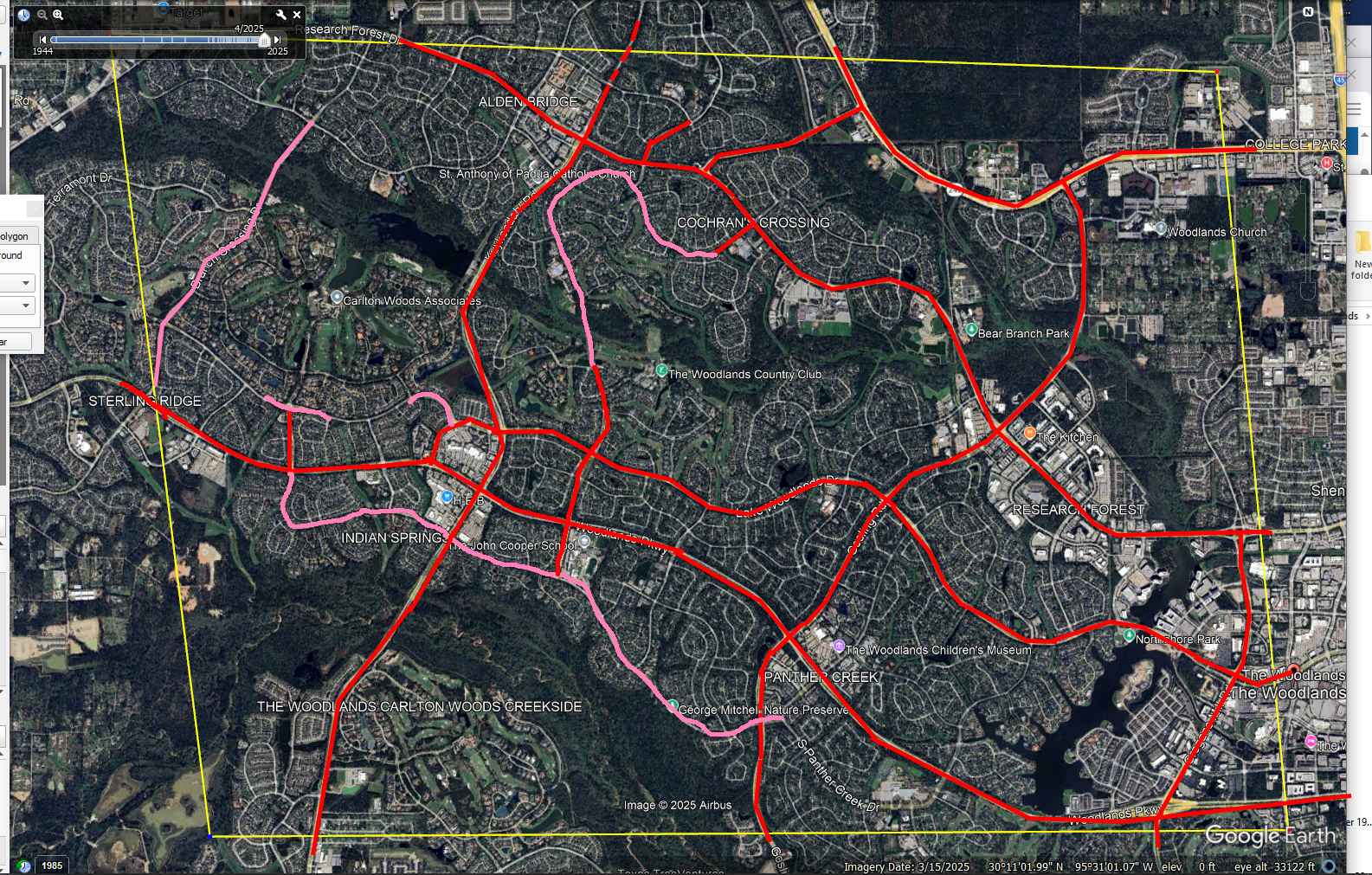
What I think they mean is that The Woodlands actually has largely complete arterials instead of just roads that just randomly appear and disappear. Here's a 25 square mile map of The Woodlands with the major arterials (4+ lanes) marked in red, with two lanes (but still "major") in pink. Makes sense, right? There's a grid, not exactly east-west, but still functional. Many of the roads go well past these borders.


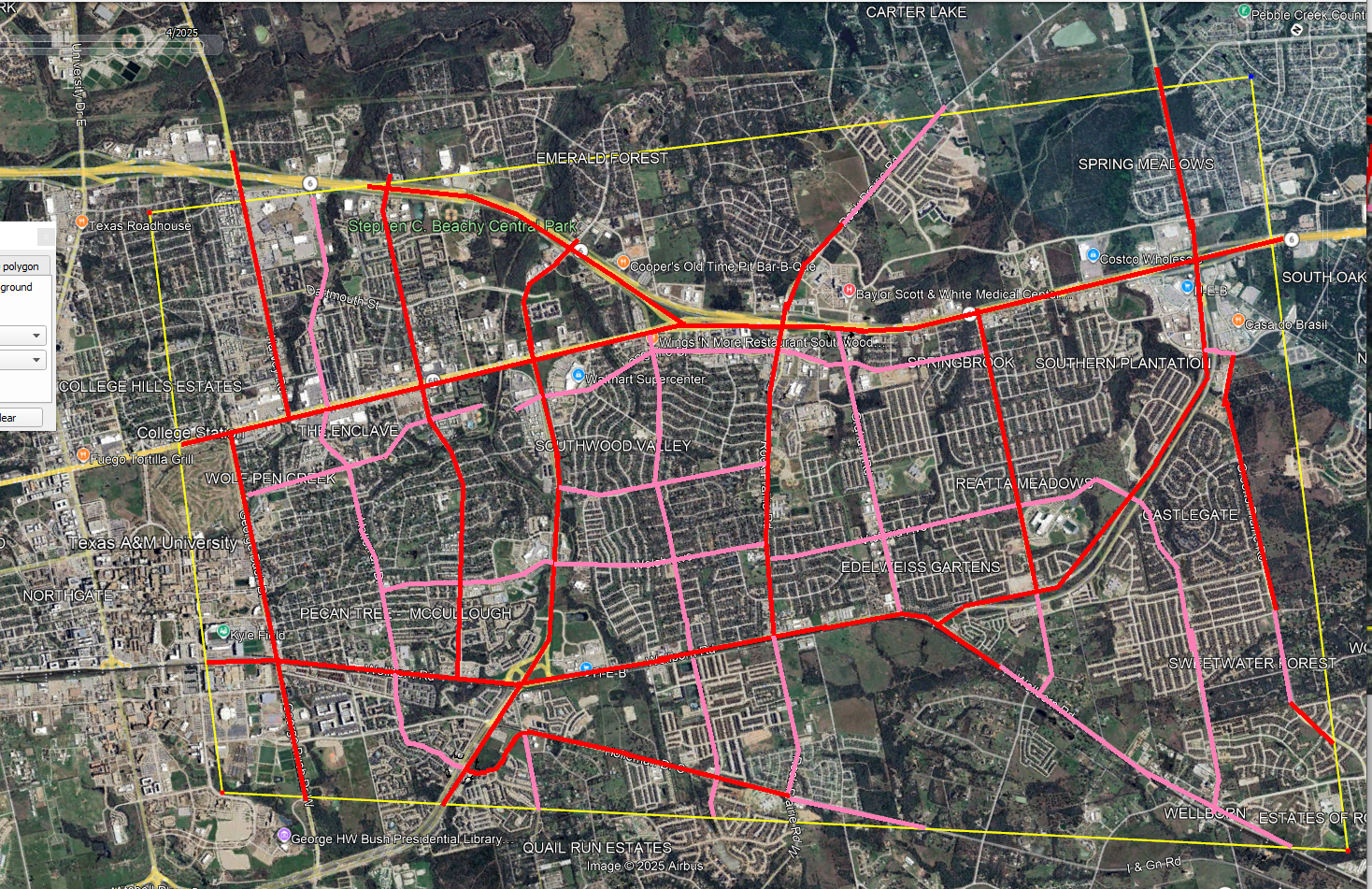
Meanwhile, here's College Station.


One of the biggest major roads, Texas Avenue South, just disappears mid-way, there's only two lane roads everywhere and they don't connect to each other at all (some of The Woodlands do, they just aren't marked). Even if there's fewer two lane streets available to use in The Woodlands, their roads actually go somewhere. Much of the traffic issues in our area are from people trying to squiggle through larger roads to connect to smaller ones. Unfortunately this isn't SimCity so you can't just rev up the bulldozers and build connections where needed like connecting Longmire to Anderson, or connect Texas Avenue to Midtown somehow, or make Holleman Drive South the Jones-Butler Road it originally was and intended to be without making it 10 times worse in the process (and that's already been mucked up with that traffic circle)...and frankly the mess with that traffic circle is because there's basically no way to escape the university. They should've made Dexter Drive a four-lane road all the way to Southwest Parkway (and beyond) years ago. We can't even have the two-lane major streets anymore because residents get their feelings hurt when something like that is proposed (Pebble Creek Parkway).

Bob Yancy
How long do you want to ignore this user?
PS3D said:

Bob Yancy said:

doubledog said:

Bob Yancy said:

PrimeCSTX said:

So where did this end up after the meeting?


We need the flexibility of both. Right now it's 80/20 but staff and P&Z are good about allowing variances when it makes sense. It's not a disaster. Our city is very well zoned and organized compared to most.


Bob, we should be on the same level as say The Woodlands, not where we are at now. IMHO


Sooo funny you say that. The Woodlands is famous, some say infamous, for embracing the quiet enclave neighborhood and compelling all traffic outside of them. By policy. Definitively and at every turn. They have the traffic on their arterials and I-45 to prove it, too. They are the textbook case.

That's the trade off decision they made as a community and it took root. It also earned them the reputation of being one of the most admired master planned communities in Texas- but with arterial traffic problems.

I don't advocate to that extreme of "enclave-ism" - I just want us to be balanced without Herculean effort for citizens and staff.

Respectfully

Yancy '95

What I think they mean is that The Woodlands actually has largely complete arterials instead of just roads that just randomly appear and disappear. Here's a 25 square mile map of The Woodlands with the major arterials (4+ lanes) marked in red, with two lanes (but still "major") in pink. Makes sense, right? There's a grid, not exactly east-west, but still functional. Many of the roads go well past these borders.


Meanwhile, here's College Station.


One of the biggest major roads, Texas Avenue South, just disappears mid-way, there's only two lane roads everywhere and they don't connect to each other at all (some of The Woodlands do, they just aren't marked). Even if there's fewer two lane streets available to use in The Woodlands, their roads actually go somewhere. Much of the traffic issues in our area are from people trying to squiggle through larger roads to connect to smaller ones. Unfortunately this isn't SimCity so you can't just rev up the bulldozers and build connections where needed like connecting Longmire to Anderson, or connect Texas Avenue to Midtown somehow, or make Holleman Drive South the Jones-Butler Road it originally was and intended to be without making it 10 times worse in the process (and that's already been mucked up with that traffic circle)...and frankly the mess with that traffic circle is because there's basically no way to escape the university. They should've made Dexter Drive a four-lane road all the way to Southwest Parkway (and beyond) years ago. We can't even have the two-lane major streets anymore because residents get their feelings hurt when something like that is proposed (Pebble Creek Parkway).


It's a conundrum, traffic. Both sides are essentially correct depending upon the goal.

I don't see your attachments. FYI

Respectfully

Yancy '95
Bob Yancy
How long do you want to ignore this user?
https://share.google/aimode/pbfikT0bjPNF1hbsk


"Based on municipal thoroughfare data and structural network designs, College Station has more linear miles of arterial roadways than The Woodlands."

"Network Comparisons"

"College Station: Operates as an independent city center with an expansive grid that relies on a higher volume of strategic arterials. Major corridors like Texas Avenue, University Drive, and Harvey Mitchell Parkway (FM 2818) serve the heavy traffic volumes of a university town. The entire regional Metropolitan Planning Organization (MPO) network, which heavily features College Station's network, coordinates over 124 centerline miles of core regional paths."

"The Woodlands: Built as a master-planned community specifically designed to minimize heavy internal thoroughfare grids. It emphasizes winding residential streets and loops. The community restricts high-volume through-traffic to just a few major, heavily landscaped arterial spines like The Woodlands Parkway, Research Forest Drive, and State Highway 242."
Bob Yancy
How long do you want to ignore this user?
Bob Yancy said:

https://share.google/aimode/pbfikT0bjPNF1hbsk


"Based on municipal thoroughfare data and structural network designs, College Station has more linear miles of arterial roadways than The Woodlands."

"Network Comparisons"

"College Station: Operates as an independent city center with an expansive grid that relies on a higher volume of strategic arterials. Major corridors like Texas Avenue, University Drive, and Harvey Mitchell Parkway (FM 2818) serve the heavy traffic volumes of a university town. The entire regional Metropolitan Planning Organization (MPO) network, which heavily features College Station's network, coordinates over 124 centerline miles of core regional paths."

"The Woodlands: Built as a master-planned community specifically designed to minimize heavy internal thoroughfare grids. It emphasizes winding residential streets and loops. The community restricts high-volume through-traffic to just a few major, heavily landscaped arterial spines like The Woodlands Parkway, Research Forest Drive, and State Highway 242."


"The Woodlands experiences significantly more severe overall traffic congestion than College Station. <Nod to staff's approach is duly inserted here>


"While College Station experiences localized gridlock during Texas A&M University rush hours and major game-day events, its overall baseline traffic does not compare to the daily bottlenecking found in The Woodlands.

The main drivers behind the difference in congestion include:1. Major Highway BottlenecksThe Woodlands: The community is bisected by Interstate 45, which is heavily populated by Houston-bound commuters. The Texas A&M Transportation Institute (TTI) regularly ranks several road segments in and around The Woodlandsincluding I-45, Rayford Road, Research Forest Drive, and Woodlands Parkwayamong the most congested roadways in the state.

College Station: Major routes like Highway 6 and Texas Avenue see heavy flow, but they rarely face the long, multi-hour regional gridlock typical of the Greater Houston commuter basin.2.

"Commuter Patterns vs. Localized Spikes"

"The Woodlands: Suffers from standard, predictable, and punishing large-metropolitan morning and evening rush hours. Traffic crawls as tens of thousands of residents attempt to exit or enter the master-planned network simultaneously.

"College Station: Congestion is highly cyclical and tied closely to the university. Severe gridlock is mostly compressed into class-change times, moving weekends, or the massive influx of over 100,000 visitors on football game days. Outside of these times, the city's thoroughfare grid clears up rapidly.3.

Population Density and Metro Influence

"The Woodlands: Directly absorbs the spillover of being part of the Houston-The Woodlands-Sugar Land metroplex, which consistently ranks as one of the top 20 most congested areas in the United States.

College Station: Operates as a distinct, standalone small-to-midsize urban area, allowing it to maintain a lower baseline volume of daily commercial freight and pass-through commuters."

If you are interested, we can look closer into the average commute times for residents in both areas or review specific upcoming expansion projects planned by TxDOT for I-45 or State Highway 6?

Me: yes, please. And after you answer that, tell me who experiences worse traffic after controlling for population density.


Me: so any fair and objective reading justifies staff's approach if getting there faster and spending less time on the road is the goal- which of course it must be.

The tradeoff for efficient mobility versus a quiet neighborhood is a balancing act with every decision.

Yancy out

Respectfully
PS3D
How long do you want to ignore this user?
Bob Yancy said:


It's a conundrum, traffic. Both sides are essentially correct depending upon the goal.

I don't see your attachments. FYI

Respectfully

Yancy '95

The Woodlands
College Station

Bob Yancy said:

(snip)

I would consider asking AI to argue your case and put that as a response embarrassing, but I'll overlook that. I didn't say The Woodlands was a "good" case as they don't have the smaller street system that College Station does, but their commute time is heavily skewed because Interstate 45 is a busy highway to begin with, you're also getting Conroe and every other truck traveling between here and Dallas, far worse than Highway 6.

There's also the fact that in the maps I added many of the roads extend far beyond those borders, with Kuykendahl Road, for instance, continuing down to almost Beltway 8. None of this excuses the fact that the road grid in College Station is extremely broken, caused by years of "neighborhood resistance" with no way of getting better anytime sooner without some hard choices.
Bob Yancy
How long do you want to ignore this user?
PS3D said:

Bob Yancy said:


It's a conundrum, traffic. Both sides are essentially correct depending upon the goal.

I don't see your attachments. FYI

Respectfully

Yancy '95

The Woodlands
College Station

Bob Yancy said:

(snip)

I would consider asking AI to argue your case and put that as a response embarrassing, but I'll overlook that. I didn't say The Woodlands was a "good" case as they don't have the smaller street system that College Station does, but their commute time is heavily skewed because Interstate 45 is a busy highway to begin with, you're also getting Conroe and every other truck traveling between here and Dallas, far worse than Highway 6.

There's also the fact that in the maps I added many of the roads extend far beyond those borders, with Kuykendahl Road, for instance, continuing down to almost Beltway 8. None of this excuses the fact that the road grid in College Station is extremely broken, caused by years of "neighborhood resistance" with no way of getting better anytime sooner without some hard choices.


Embarrassing how? I didn't ask it to make a case. I asked it to answer factual questions regarding area miles, linear miles of arterial, and I asked it to control for population density. There's no leading questions there.

In your case, you are repeatedly making subjective value statements and presenting them as fact. I value that feedback. That's why I started this thread with a poll- to ascertain the bosses' opinions on the matter.

Thanks for your feedback.

Respectfully

Yancy '95
PS3D
How long do you want to ignore this user?
Bob Yancy said:


Embarrassing how? I didn't ask it to make a case. I asked it to answer factual questions regarding area miles, linear miles of arterial, and I asked it to control for population density. There's no leading questions there.
In your case, you are repeatedly making subjective value statements and presenting them as fact. I value that feedback. That's why I started this thread with a poll- to ascertain the bosses' opinions on the matter.
Thanks for your feedback.
Respectfully
Yancy '95

Sorry...in what way have I made "subjective value statements"?

Is it not true that Interstate 45 carries much more traffic from outside The Woodlands that could skew commute times?
Is it not true that The Woodlands lacks the sort of streets that College Station does have like Welsh, Longmire, and Deacon?
Is it not true that it's difficult to even do as much as extend Pebble Creek Parkway to a different neighborhood?
Is it not true that we can't just bulldoze our way through neighborhoods to build proper arterials?
Is it not true that residents suffer from motorists cutting through their neighborhoods because the major roads are in the wrong place, or too crowded?
Is it not true that Dexter Drive was planned to be a four-way road at one point?
Is it not true that the university dumps too much traffic on too few roads?

The Woodlands and College Station are two very different areas, and merely trying to approximate control for population density is ignoring a number of other variables.
TXAG 05
How long do you want to ignore this user?
AG
Plus, of course Woodlands people have longer commutes since a lot of them are driving into Houston everyday, where in BCS, most people aren't going more than a couple miles.
Refresh
Page 1 of 1
 
×
subscribe Verify your student status
See Subscription Benefits
Trial only available to users who have never subscribed or participated in a previous trial.